Hearing loss is not always easy to recognize. Some people can hear sounds but struggle to understand words, particularly during group conversations, phone calls or discussions in noisy places. Others gradually increase the television volume without noticing the change. An audiometry hearing test helps measure these difficulties and provides a clearer picture of how well each ear is functioning.
Audiometry is a painless diagnostic assessment that measures hearing sensitivity at different pitches and volume levels. It can be performed for adults, older people and children who are able to respond reliably to sounds.
What happens during an audiometry test?
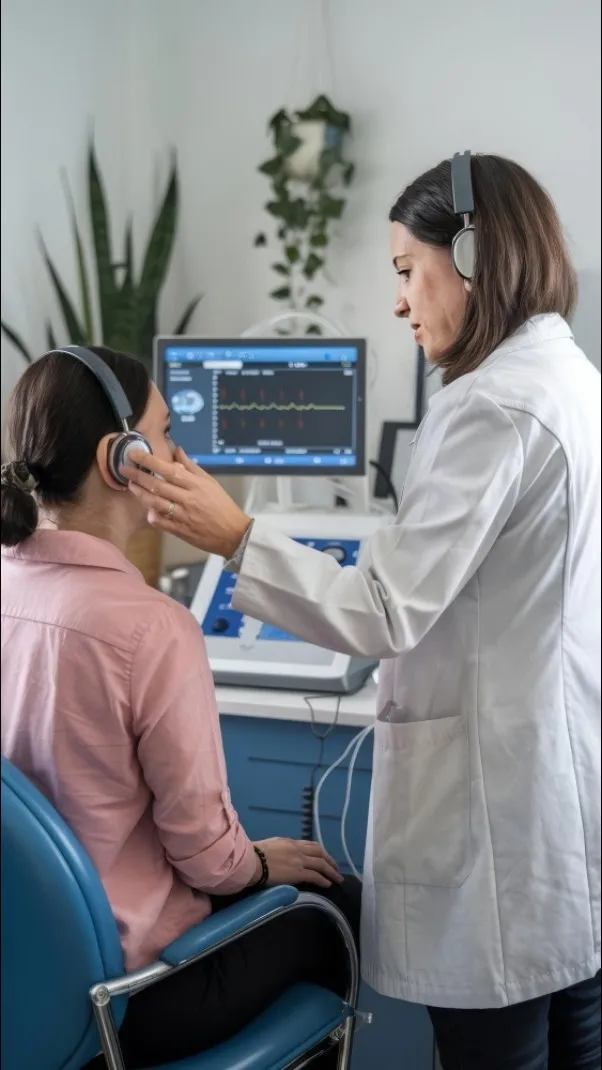
During pure-tone audiometry, the patient wears headphones or earphones and listens to a series of tones. These tones vary from low to high pitch and from louder to very soft levels. The patient indicates whenever a sound is heard, even if it is faint.
Each ear is evaluated separately. The results are plotted on an audiogram, a graph showing the quietest sounds the person can detect across different frequencies.
Depending on the symptoms, the hearing assessment may also include:
- Speech audiometry: Measures the ability to hear and recognize spoken words.
- Bone-conduction testing: Helps identify whether hearing difficulty involves the outer, middle or inner ear.
- Impedance audiometry: Checks eardrum movement and middle-ear pressure.
- Speech discrimination testing: Determines how clearly words are understood at a comfortable listening level.
The combination of tests is selected according to the patient’s age, symptoms and medical history.
Signs that suggest you may need a hearing test
An audiometry hearing test may be helpful if you:
- Frequently ask people to repeat themselves
- Have difficulty following speech in background noise
- Hear better through one ear than the other
- Increase the volume of televisions or mobile devices
- Experience ringing or buzzing in the ears
- Have recurrent ear infections
- Feel pressure or blockage in an ear
- Work in an environment with regular noise exposure
Children may require testing when they have delayed speech, inconsistent responses to sound, recurrent ear infections or difficulty following verbal instructions in school.
How to prepare for the assessment
Audiometry usually requires no special preparation. Patients should, however, inform the clinician about ear pain, discharge, recent infections, tinnitus, dizziness, previous ear surgery and exposure to loud noise.
The ear canal may be examined before the test. Wax accumulation, inflammation or another blockage can influence the result. If such a condition is present, it may need to be managed before accurate testing is completed.
At Dr. Navalakhe ENT Clinic, Dr. Milind Navalakhe evaluates hearing concerns together with the patient’s broader ear health. This is important because the audiogram identifies the pattern of hearing difficulty, while the ENT examination helps investigate its possible cause.
Understanding the audiogram
The results can indicate:
- Whether one or both ears are affected
- Which sound frequencies are difficult to hear
- The degree of hearing loss
- Whether the loss appears conductive, sensorineural or mixed
- How clearly speech is recognized
Based on these findings, the next step may involve observation, treatment for an ear condition, further testing, hearing protection or hearing rehabilitation.
For residents of Parel and nearby areas of Mumbai, Maharashtra, timely audiometry can provide an objective answer when communication becomes difficult. Early assessment is especially useful for children, older adults and people exposed to occupational noise.
Keywords