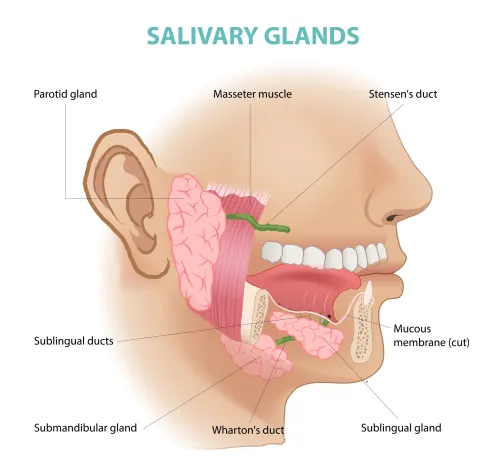
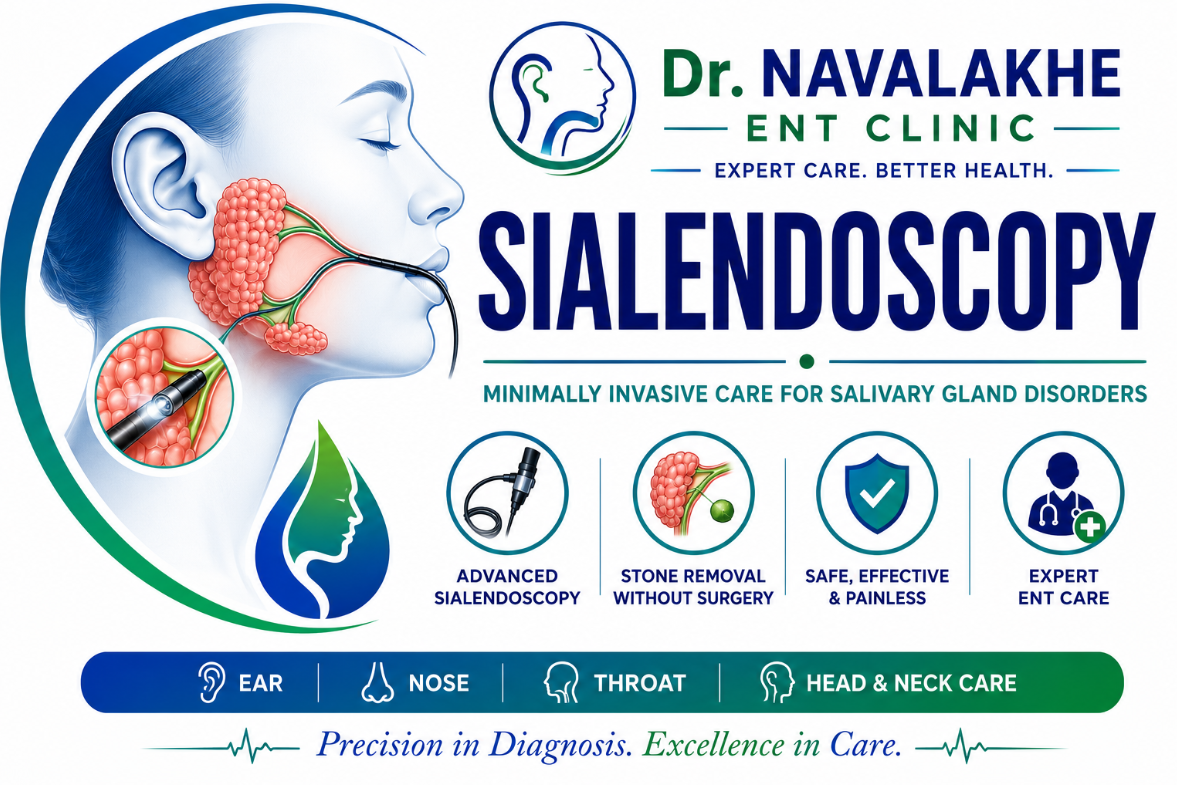
Recurrent swelling or pain around a salivary gland, particularly during meals, can sometimes result from obstruction within a salivary duct. Salivary stones and duct narrowing are common causes. Traditionally, some persistent cases required open surgery, but sialendoscopy now provides a minimally invasive option for selected patients.
Sialendoscopy uses a very small endoscope to examine the salivary duct from inside. It allows the surgeon to visualise portions of the duct system and, in suitable cases, address stones, narrowing, or other obstructive problems while attempting to preserve the gland.
The important distinction is that sialendoscopy and conventional salivary gland surgery are not interchangeable treatments for every condition.
Sialendoscopy may be considered when investigations suggest an obstructive duct problem. Depending on the stone's size, location, mobility, and surrounding anatomy, instruments may be passed through the endoscope to help retrieve it. Narrowed ducts may sometimes be treated through endoscopic techniques.
Conventional surgery may remain necessary when:
- A stone is too large or inaccessible for endoscopic removal alone
- Disease has caused significant gland damage
- A tumour is suspected or confirmed
- The anatomy prevents an endoscopic solution
- Previous treatment has not resolved the problem
Some cases may require a combined approach rather than choosing exclusively between endoscopy and open surgery.
For someone considering sialendoscopy in Mumbai, evaluation usually starts with a detailed history. Pain or swelling that becomes more noticeable while eating is particularly relevant because saliva production increases during meals. Examination and imaging can then help locate an obstruction and determine whether endoscopic treatment is technically appropriate.
One potential advantage of sialendoscopy in selected obstructive conditions is the possibility of treating the duct while preserving the salivary gland. Because the procedure uses natural duct openings, it may avoid a conventional external incision in suitable cases. These advantages should still be weighed against the specific anatomy and diagnosis rather than assuming that minimally invasive treatment is always possible.
At Dr. Navalakhe ENT Clinic, patients with recurrent salivary gland swelling or suspected duct obstruction can be evaluated to determine the underlying cause and appropriate treatment pathway. Availability and suitability of a particular intervention depend on individual findings.
Across Mumbai and Maharashtra, people increasingly search for gland-preserving options when dealing with salivary stones. The useful starting point is a precise diagnosis rather than selecting a procedure by name.
If swelling repeatedly appears around mealtimes, infections recur, or a previously diagnosed salivary stone continues to cause symptoms, an ENT assessment can clarify whether observation, medical management, sialendoscopy, a combined procedure, or conventional surgery is the more appropriate option.
Keywords